Which Big Bash Teams Time the Power Surge Best?
A deep-dive into Power Surge timing in the BBL, separating decision quality from execution quality to see which teams use it most effectively
Stephen O’Keefe bowled the first Power Surge over the BBL had ever seen. It went for 19.
It was BBL|10, the rule’s debut season, and every signal in that first over pointed the same way: the Surge was a licence to print runs, two overs of fielding restrictions dropped into the middle of an innings like a gift. A few weeks later, Melbourne Stars captain James Vince called his own Surge chasing a target, reasoning the same way — bring the required rate down, seize control. Instead, the Stars got squeezed. “We thought if we could take it, we could get the rate right down and get ahead in the game,” Vince said afterwards, “but it actually had the opposite effect. They bowled well and we couldn’t really get them away, then we lost some momentum.”
Two overs. Two very different outcomes. Same rule.
The Power Surge is the BBL’s take on a batting powerplay — two overs the batting team can trigger at any point after the halfway mark of their innings, during which only two fielders are permitted in the outfield. Unlike the mandatory powerplay at the top of the innings, the Surge is optional and timed: the batting team decides when to call it, which makes that decision itself a meaningful strategic variable. It’s also a two-part decision — when to call it, and what to do once it’s called — and it’s the gap between those two parts that made Vince’s over such a mess.
That gap is the whole problem with judging the Power Surge by results alone. A team scores 20 and looks decisive; another scores 8 and looks reckless. But the 20 might have come from a team that called it in ideal conditions and executed only averagely. The 8 might have come from a team in genuine difficulty who extracted everything the situation allowed — Vince’s situation, more or less. Raw Surge runs collapse both dimensions into one number, and that collapses the question.
So I built a model of expected Surge runs — what a team should score given the conditions at activation — and used the gap between expected and actual to measure execution independently of decision quality. The aim is to answer a more useful question than “how many runs did they score”: did they call it well, and did they then play it well? Those turn out to be two different skills, and not every team is good at both — which is exactly what Vince’s over shows.
When are teams actually calling it?
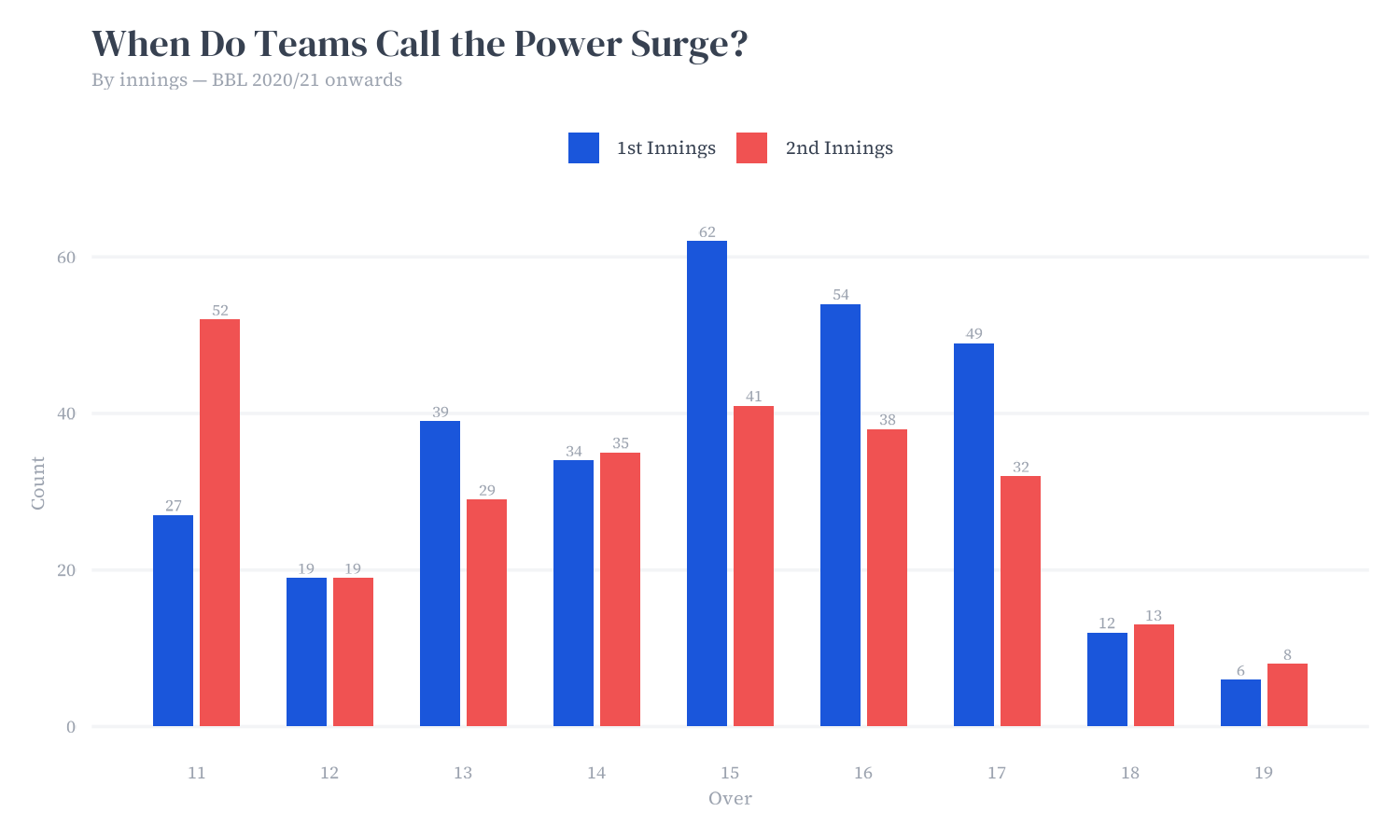
The first-innings picture is measured — teams spread the Surge across overs 15–18, taking their time, picking their moment. The second-innings picture is the one worth scrutinising. Teams chasing overwhelmingly call the Surge at the earliest opportunity, overs 11 and 12. On the surface, that looks aggressive — front-foot cricket, seizing the initiative. But a meaningful share of those early calls come from teams already behind the required rate, reaching for a lifeline rather than pressing an advantage. It’s the same instinct that cost Vince and the Stars their over against a bowling attack that simply had the better day.
Any model of Surge value needs to account for this. A Surge called from desperation and a Surge called from strength are structurally different events, and lumping them together produces misleading conclusions about what “good timing” even means.
xSurge: what should a team score?
Expected Surge runs — xSurge — is what the model predicts a team should score given the match state at activation. The concept is analogous to expected goals in football: a context-adjusted baseline that makes different situations comparable, so a Surge called at 4/40 chasing 180 isn’t judged by the same yardstick as one called at 1/90 defending a total.
Building the model
I started with every match-state variable available at the moment of the Surge decision: over called, wickets in hand, the run-rate gap versus target, recent scoring rate, and balls faced by each batter at the crease. The outcome is actual Surge runs — the total scored across the two Power Surge overs.
The model is a linear regression, not something more complex. With roughly 240 Surges across four seasons, the sample size doesn’t support a high-dimensional model without overfitting. More importantly, interpretability is the goal here. I want to understand each predictor’s contribution to expected Surge value, not optimise predictive accuracy on held-out data.
Two predictors were tested and dropped before the final model:
Recent scoring rate — the team’s run rate in the overs immediately preceding the Surge. Intuition says a team already scoring freely should carry that momentum into the Surge. The data disagrees: after controlling for wickets in hand and over called, the correlation was next to nothing.
Balls faced by the less settled batter — this one I’ll return to in the next section, because the finding is more interesting than a simple removal.
The final model:
xSurge = f(over_called, wickets_in_hand, balls_senior)All predictors are observable at the decision point — no future information enters. Each has a clear interpretation:
- Over called — the later the Surge is taken, the fewer batting resources remain. Later is worse, all else equal.
- Wickets in hand — the strongest predictor. Teams with 7+ wickets at activation materially outscore those who have burned through the top order.
- Balls faced by the more settled batter — how long the dominant batter has been in. More on this below.
The R² is modest. That’s expected: two overs of T20 batting in identical conditions can produce anywhere from 8 to 30 runs, and the model can’t predict that variance. What it does is set a principled, context-adjusted expectation — which is all xSurge needs to be.
The batter settledness finding
Ask a captain when both batters need to be “in” before triggering the Surge, and most will tell you: both of them. Get your set batter and your other set batter, then go. It’s the kind of rule of thumb that sounds obviously right — until the data is asked to back it up.
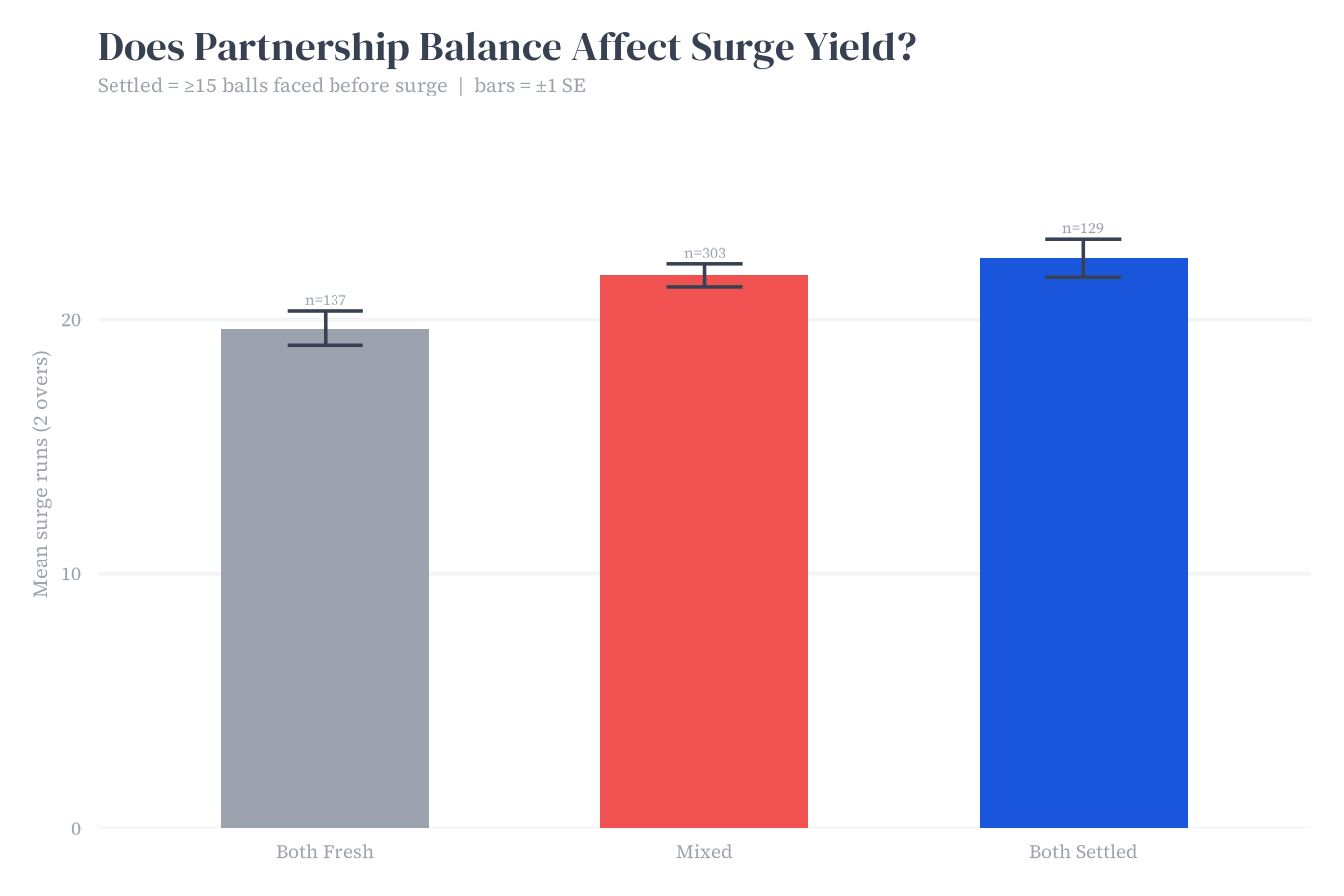
Both-fresh partnerships do score materially less — that part of the intuition holds. But once one batter is set, adding a second settled batter makes no detectable difference. Mixed partnerships and both-settled partnerships yield virtually identical Surge runs. The pairwise tests confirm it: Both Fresh versus Mixed is significant; Mixed versus Both Settled is not.
The implication is more precise than the folklore. One anchor is enough. If the dominant batter has had time to read the conditions, the Surge is ready. Holding it longer — hoping the second batter also settles — buys nothing the data can find. This is why balls_senior enters the xSurge model, but balls_junior doesn’t. It’s probably the single most actionable line in this whole piece: stop waiting on the junior partner.
Separating decision quality from execution quality
With xSurge defined, every historical Surge activation gets two numbers.
Decision quality — the xSurge value at activation. High xSurge means the team called it in a good state: wickets in hand, appropriate timing, not under excessive pressure. This is a measure of the decision, independent of what actually happened next.
Execution quality — actual Surge runs minus xSurge. Positive means the team scored more than conditions predicted; negative means they underdelivered relative to what the situation offered.
These two dimensions are genuinely independent. A team can call the Surge in excellent conditions and underdeliver — Vince had 5 wickets in hand and a set batter at the crease when the Stars called theirs; the conditions were fine, the execution wasn’t. Another team can call it in difficult conditions and beat expectations anyway. Treating them as one number, raw Surge runs, hides which problem a team actually has.
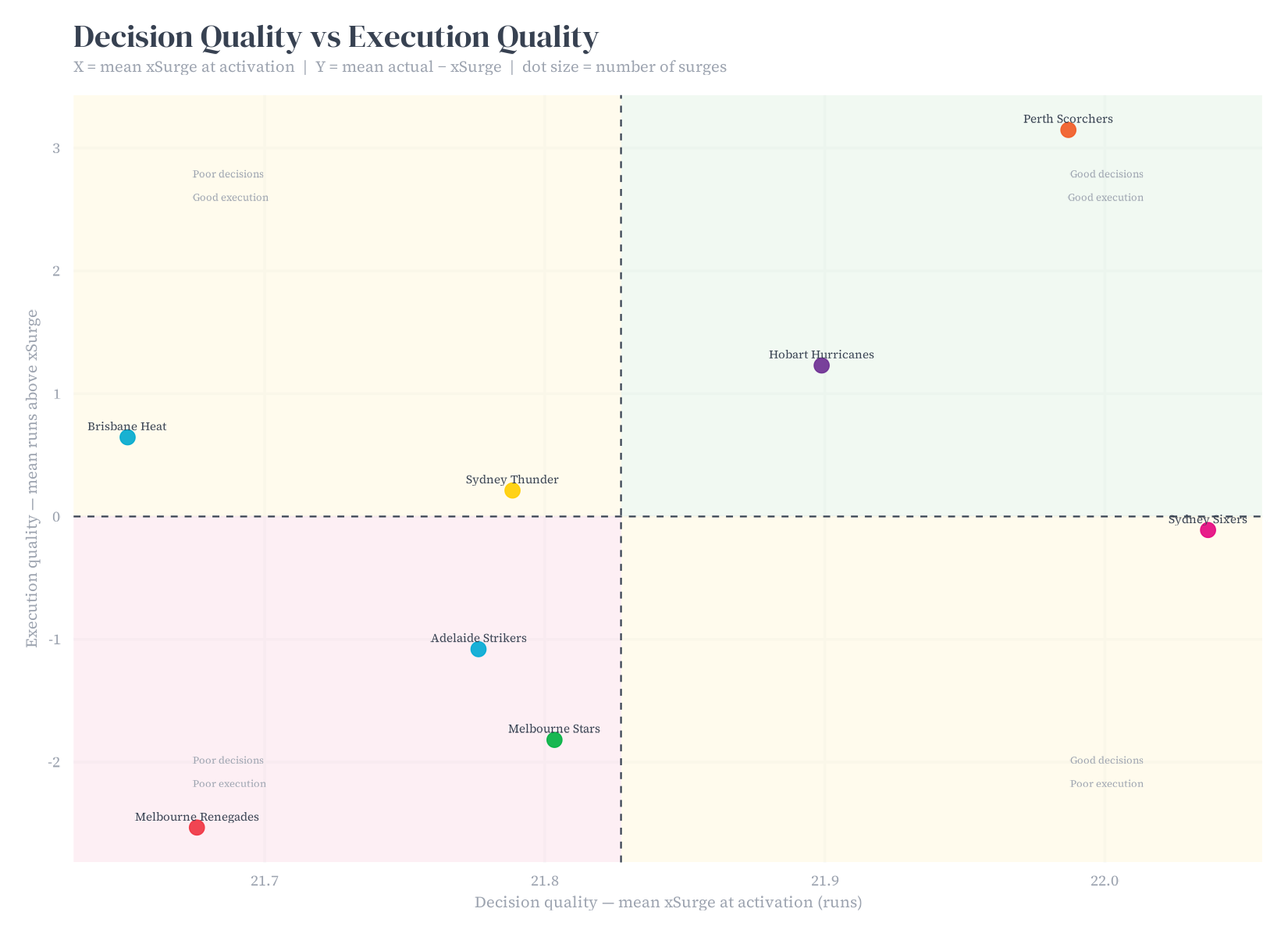
This is where you find out whether a team has a decision problem or a batting problem — and they call for entirely different fixes. Teams in the top-right are good at both: they activate in strong states and score above expectation once they do. Teams in the bottom-left have a compounding problem. The more interesting quadrants are the off-diagonals — teams that make good decisions but underdeliver in execution, and teams that consistently call the Surge in poor states but somehow exceed the modest expectations that creates.
A team in the bottom-right needs a conversation about when to trigger the Surge — their decision-making is leaving value on the table before a ball is bowled. A team in the top-left needs a different conversation entirely — about how they actually bat once the fielders come in.
A complementary view strips away the xSurge adjustment altogether and looks at raw outputs: how many runs did each team score, and how many wickets did they lose getting there?
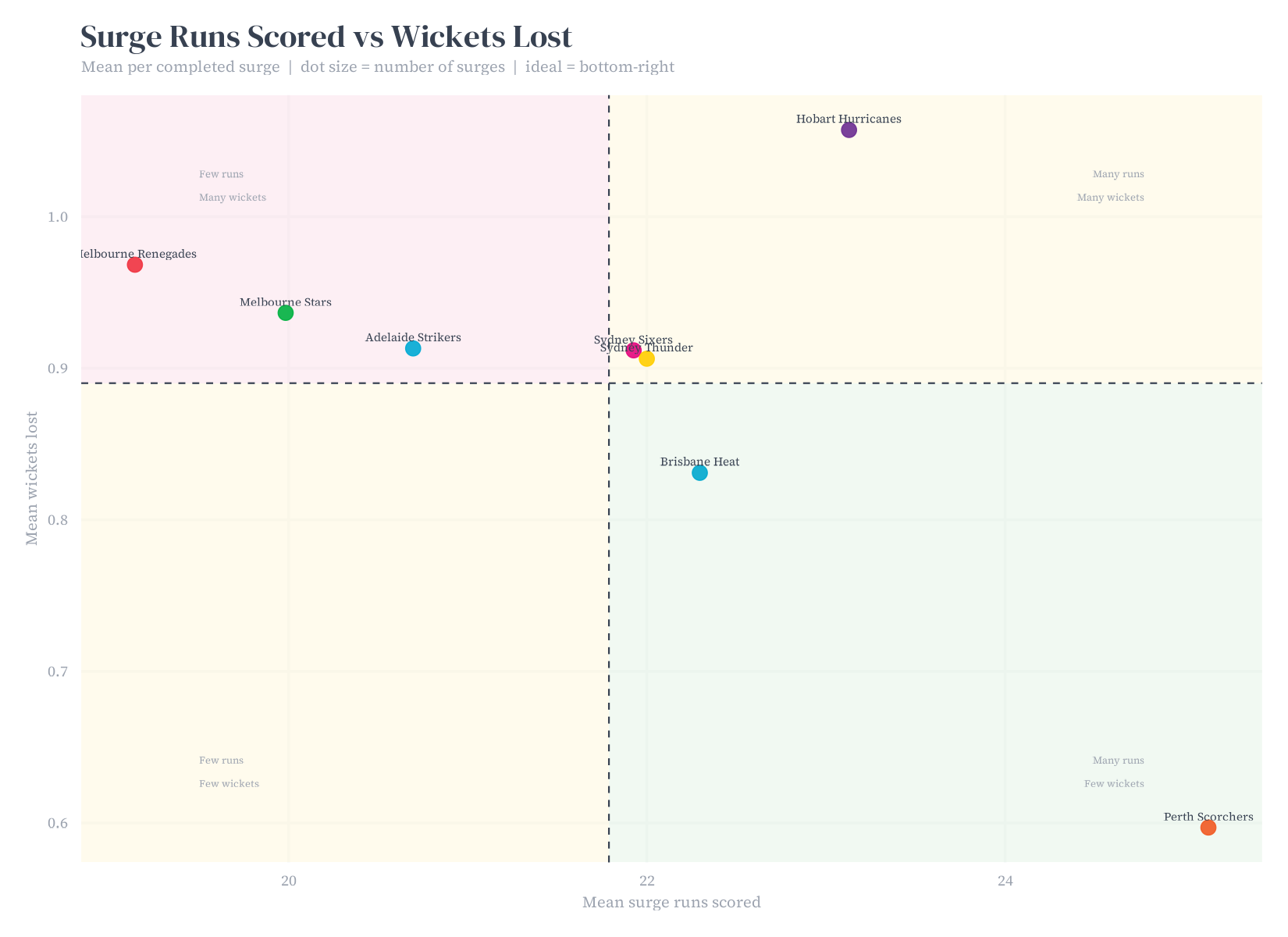
The ideal quadrant is bottom-right — high runs, few wickets. Teams there are extracting the most from the phase without burning through their batting order. Teams in the top-left are getting the worst of both outcomes. The off-diagonals are the interesting cases: teams that score heavily but at significant wicket cost, and teams that protect their wickets but fail to convert the opportunity into runs.
What the data suggests
Three things, in order of confidence.
Wickets in hand is the decision variable that matters most. Fixation on finding the right over number misses the point. The model says: protect your wickets into the Surge window. A team with 8 wickets at over 13 is in a structurally better position than a team with 4 wickets at over 11 — not because of the over number, but because of what that wicket state allows.
One settled batter is enough. The intuition that both batters need to be in says to wait. The data says that once the dominant batter is set, waiting longer for the junior partner has no measurable payoff. This is probably the most directly actionable finding for a captain.
Decision quality and execution quality are separate problems. A team that systematically calls the Surge in poor states needs a process change — clearer decision triggers, better reading of match state. A team that calls it in fine states and underperforms needs a different intervention entirely. The xSurge framework doesn’t resolve those conversations, but it makes it possible to have the right one.
None of which would have helped James Vince much in the moment. His read of the situation — set batter in, wickets in hand, chase still alive — was defensible by every measure this model uses. Some days the bowlers just turn up. But knowing that it was a good decision that ran into good bowling, rather than a bad decision full stop, is exactly the distinction a coach needs before deciding what to actually change.